
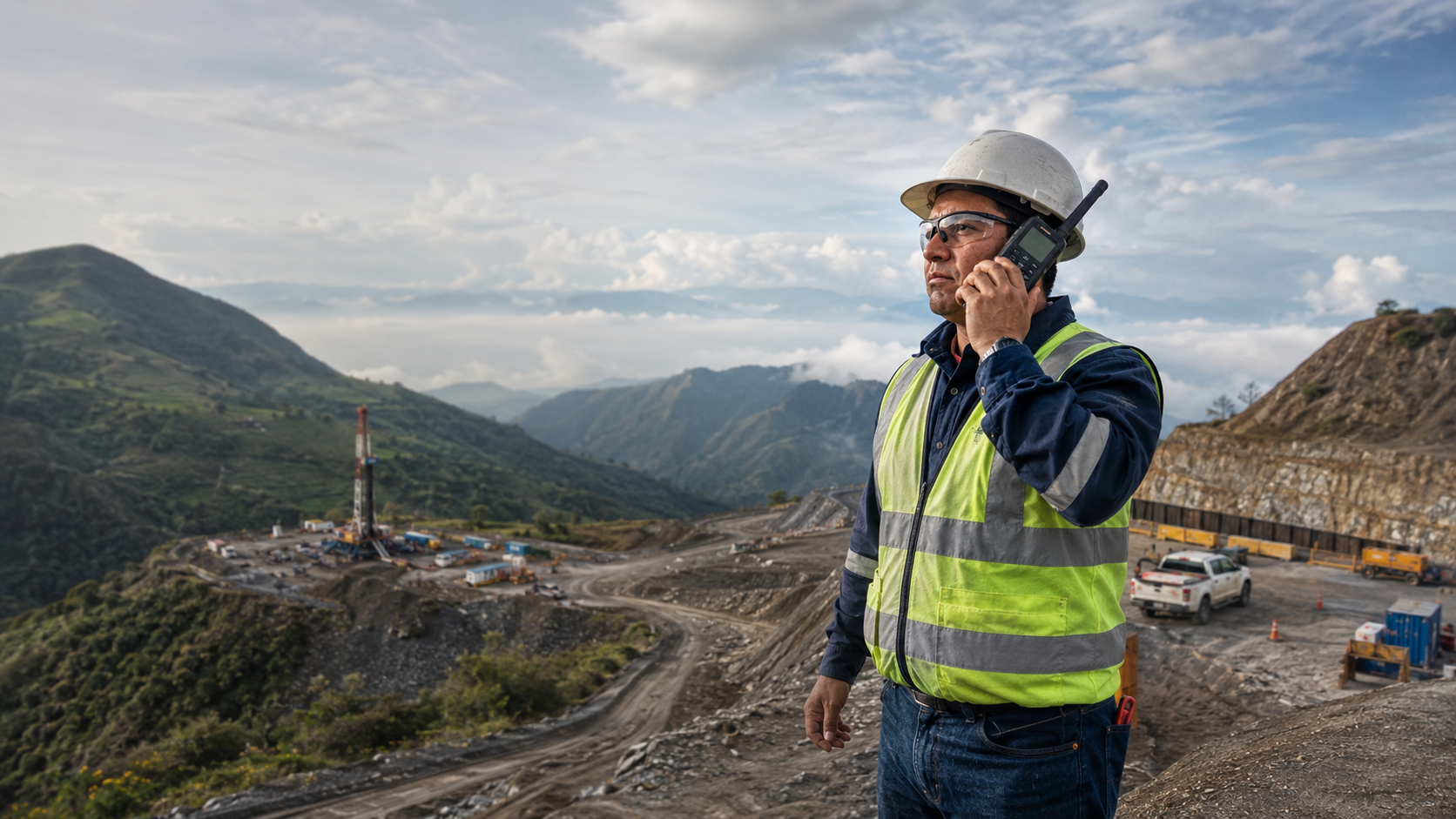
Most mining and energy operations in Colombia aren't in the city. They're in rural areas, often hours from the nearest town, in places where cellular coverage isn't part of the available infrastructure.
It's the nature of the business: the deposit is where it is, not where there's signal. Yet some operations still depend on “whatever signal you can catch” at a specific spot on the terrain, or on a radio whose range changes with local conditions.
Depending on whatever signal shows up isn't a communication strategy. It's a hope.
What's really at stake: reaction time.
In a mining or hydrocarbon operation, the risks aren't hypothetical: heavy machinery, work at heights or in confined spaces, handling of hazardous substances and unstable terrain. When an incident occurs, a decisive variable is how much time passes between the first alert and the activation of the response.
The call must go out from the point of the incident.
Trauma care uses the concept of the “golden hour” to highlight the value of an early response. It isn't an identical clinical limit for every case, but it's a reminder of something essential: many emergencies are time-sensitive, and the chain of help must be activated as soon as possible.
The operational priority is to reduce avoidable delays in alerting, coordination and access to care.If a worker is injured at a spot without coverage and nobody can report it immediately, the response team starts at a disadvantage that doesn't depend on the initial severity of the incident, but on the lack of a reliable channel to call for help.
The emergency plan must be executable in the field.
Colombia's Resolution 0312 of 2019 defines the minimum standards of the SG-SST (Occupational Health and Safety Management System) and includes emergency prevention, preparedness and response. Reliable communication helps turn the written protocol into a capability that can actually be executed from the operation.
Why a regular cell phone isn't a solution, even if it “sometimes works.”
It's common to hear that “there's signal at one spot on the hill” or that “the phone picks up if you climb the slope.” The problem is that this availability is neither constant nor guaranteed. It can vary with terrain, weather conditions, congestion or a failure in the carrier's infrastructure.
Occasional cellular signal
Forces people to move to a spot with coverage and depends on towers, power and terrestrial infrastructure that may be far away or out of service.
Satellite telephony
Doesn't require a nearby cell tower and allows communication from wide remote areas when the equipment has a clear view of the sky and satellite service is available.
In an emergency, it shouldn't be necessary to walk, drive or climb a mountain to find one bar of signal. The communication channel must be available where people work and where the risks are.
Important: satellite telephony shouldn't be treated as “magic” either. Its performance depends on the equipment, the network plan, the terrain, vegetation and a clear view of the sky. That's why the solution must be designed and tested for each operation.
What changes with a satellite phone in the field.
The value of the equipment isn't just in being able to make a call. It's in eliminating dead time, coordinating scattered people and giving the emergency plan a channel that works outside traditional coverage.
Communication from the exact spot
The incident report can start without waiting for someone to move to wherever “there's signal.”
Coordination between scattered crews
Each team can report its status from different work fronts, without having to be in the same cellular coverage area.
Real activation of the emergency plan
The protocol stops being just a document and gains a practical means to notify, escalate and coordinate the response from the field.
Continuity beyond emergencies
It also makes operational reports, logistics coordination and safety check-ins easier without waiting to return to a connected area.
How ECOMIL helps.
At ECOMIL we provide satellite telephony solutions for operations in areas without cellular coverage, including mining, energy and other sectors working in remote terrain.
It's not just about delivering equipment. First we understand how many work points exist, how scattered they are, what the emergency scenarios are and how each terminal will be integrated into the company's communication protocol. With that information, we define the technology, the number of devices and the testing the operation requires.
The location of the resource shouldn't determine the ability to call for help.
A mining or energy operation doesn't choose to be in an area without coverage: that's where the resource is. But it can choose not to let that limitation affect its safety. The difference between activating a response in time and losing critical minutes may lie in having a reliable way to communicate from the exact place where it's needed.